Structural wood-boring beetle remediation addresses timber degradation caused primarily by anobiid and lyctid beetles that deposit eggs inside structural framing. In historical Richland County properties across…
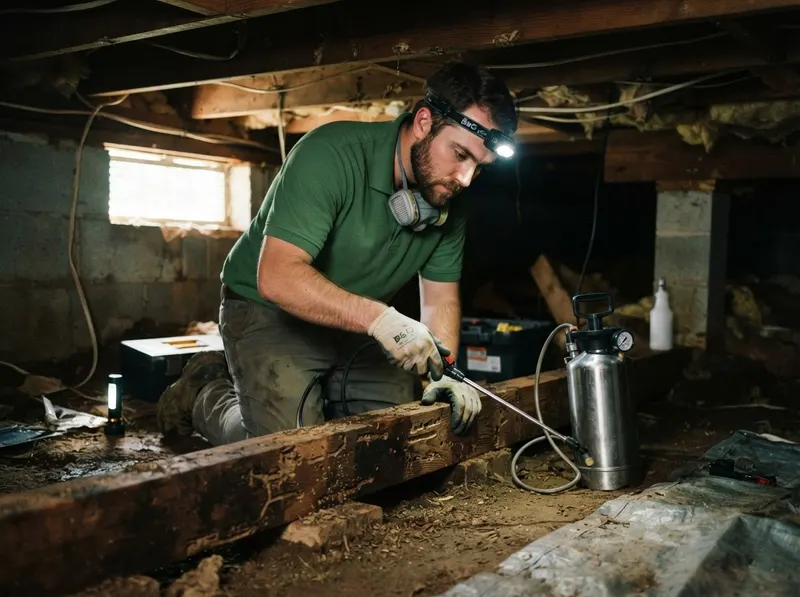
Structural wood-boring beetle remediation addresses timber degradation caused primarily by anobiid and lyctid beetles that deposit eggs inside structural framing. In historical Richland County properties across Shandon, Earlewood, and Elmwood Park, crawl space humidity routinely elevates internal timber moisture content above 16%, creating prime biological conditions for beetle larvae to feed on cellulose for 1 to 5 years. Remediating these infestations requires direct application of an EPA-registered disodium octaborate tetrahydrate (DOT) solution, which diffuses through unsealed sapwood to eliminate larvae internally. For unvarnished crawl spaces, technicians calculate linear framing footage and surface area to distribute borate salt barriers that permanently bond to wood fibers without venting dangerous vapors into residential living spaces upstairs.
Effective remediation differs fundamentally from routine surface pest spraying. Powderpost beetle exit holes (measuring 1/16 to 1/8 inch in diameter) along floor joists often indicate exit events where adult beetles have already emerged, leaving fine, talcum-powder frass behind. Surface sprays leave the hidden larvae deep inside the timber unaffected. Long-term eradication pairs targeted borate timber saturation with crawl space moisture mitigation, including 10-mil polyethylene vapor barrier installation and continuous crawl space dehumidification to drop wood moisture levels below 12%. Homes situated near Lake Katherine, Heathwood, and the floodplains flanking the Congaree River require precise wood moisture measurements using calibrated pin-type meters before application. Homeowners must note that wood-boring beetle remediation resolves active biological organisms but does not replace load-bearing framing; timber exhibiting structural compromise requires sistering or architectural repair by a licensed contractor.
Remediation protocols proceed through four standardized steps:
1. Calibrated probe testing across sill plates, rim joists, and floor supports to measure wood moisture content against standards established by the USDA Forest Products Laboratory.
2. High-pressure mechanical brushing to clear wood dust, frass, and fungal layers, exposing raw timber pores for chemical uptake.
3. Application of liquid borate salt formulations per EPA pesticide regulations directly onto all accessible faces of structural subflooring framing.
4. Ground-line vapor barrier reinforcement adhering to HUD housing guidelines to halt ambient soil evaporation.
Properties located in Cottontown, Rosewood, and Olympia often present varying crawl space clearances, ranging from 18 inches to several feet. When joists show extensive pinholes without fresh frass, monitoring protocols utilizing non-chemical insect collection traps and masking surfaces determine whether infestations are historic or active before liquid compounds are applied. Structural wood treatments do not require contract lock-ins; treatments focus on structural remediation and moisture exclusion to preserve framing integrity over decades.
Every job gets a firm, written price after a free on-site visit.
Tell us about your structural wood-boring beetle remediation job in columbia and we'll send a clear, written quote, usually the same day.
 LakeForge Exterminating