Properties across Columbia face severe biting vector pressure due to the river-basin humidity driven by the Broad River and Saluda River confluence. Targeted exterior mosquito defense targets the microhabitats where…
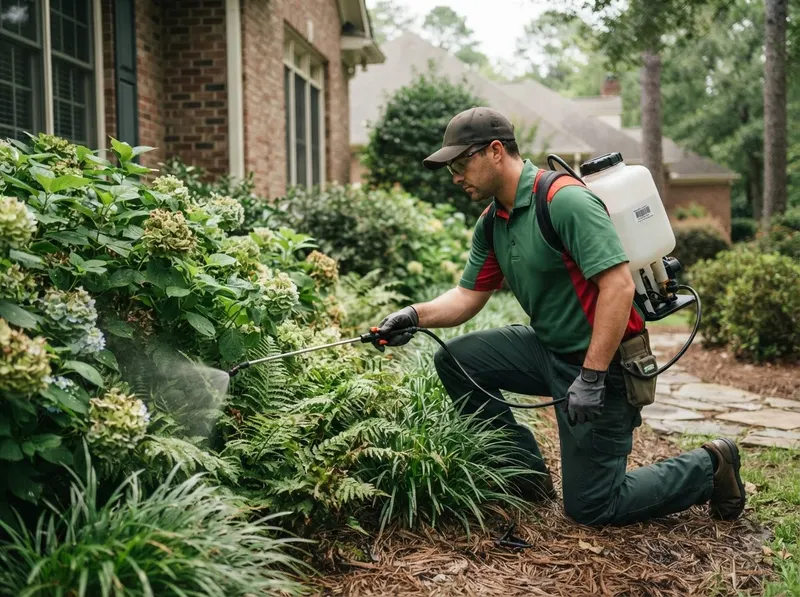
Properties across Columbia face severe biting vector pressure due to the river-basin humidity driven by the Broad River and Saluda River confluence. Targeted exterior mosquito defense targets the microhabitats where invasive vectors harbor during the daylight hours. Species such as the Asian tiger mosquito, identified systematically by the Centers for Disease Control and Prevention, feed aggressively during daylight hours and rest on the shaded undersides of broadleaf foliage, ivy beds, and groundcover. In neighborhoods like Shandon, Earlewood, and Elmwood Park, mature deciduous canopies and older architectural brick foundations create moist, low-airflow zones that shelter adult populations. Technicians conduct an engineering-grade survey to locate micro-pools of stagnant water as small as a bottle cap before initiating chemical barrier deployments. This clinical approach avoids broad-spectrum broadcast spraying across flowering turf, isolating treatment to non-flowering vegetation and structural boundaries.
Effective intervention requires addressing immature aquatic stages alongside flying adults. According to guidelines from the United States Environmental Protection Agency, biological controls such as Bacillus thuringiensis israelensis (Bti) disrupt the larval gut wall without affecting fish, predatory insects, or mammalian biology. Technicians apply these target-specific tablets to retention zones, unmaintained guttering, low-lying garden beds, and ornamental runoff channels found throughout Heathwood and Lake Katherine. Surface water protocols comply directly with biological standards set by the Clemson University Department of Pesticide Regulation, ensuring that applications match exact localized environmental requirements across South Carolina watersheds.
Structural moisture dynamics amplify vector nesting around home perimeters. In neighborhoods like Rosewood and Olympia, homes with conventional crawlspaces often pull damp air through passive foundation grates, creating elevated humidity along external footings. The Purdue University Medical Entomology department notes that adult mosquitoes retreat to these dark vertical structures to avoid daytime desiccation. Barrier protocols direct a micro-encapsulated synthetic pyrethroid onto the structural base, exterior subfloor access points, and dense hedge lines. The trade-off between thermal fogging and residual surface barriers centers on duration: thermal fogging offers immediate adult knockdown lasting roughly 24 hours, whereas clinical micro-encapsulated residual barriers adhere to leaf cuticles and masonry, resisting midlands rain wash-off to suppress biting populations for 21 to 30 days.
Property configurations dictate treatment mechanics. Parcels in Forest Acres and Cottontown featuring dense tree canopies demand mechanical backpack mist blowers that utilize air-assisted droplets measuring between 50 to 100 microns. Droplets within this spectrum, defined by the USDA Agricultural Research Service, coat foliage undersides without falling to the soil surface. Where historic properties sit near public easements like Columbia Canal and Riverfront Park or Finlay Park, technicians establish a minimum 25-foot untreated buffer from natural water bodies to protect non-target aquatic organisms, adhering strictly to safety baselines documented by the U.S. Fish and Wildlife Service and the South Carolina Department of Natural Resources. LakeForge Exterminating enforces this precision application to establish an exterior shield that minimizes indoor intrusion, preventing airborne pests from invading interior living zones without subjecting property owners to continuous chemical saturation.
Every job gets a firm, written price after a free on-site visit.
Tell us about your targeted exterior mosquito defense job in columbia and we'll send a clear, written quote, usually the same day.
 LakeForge Exterminating